
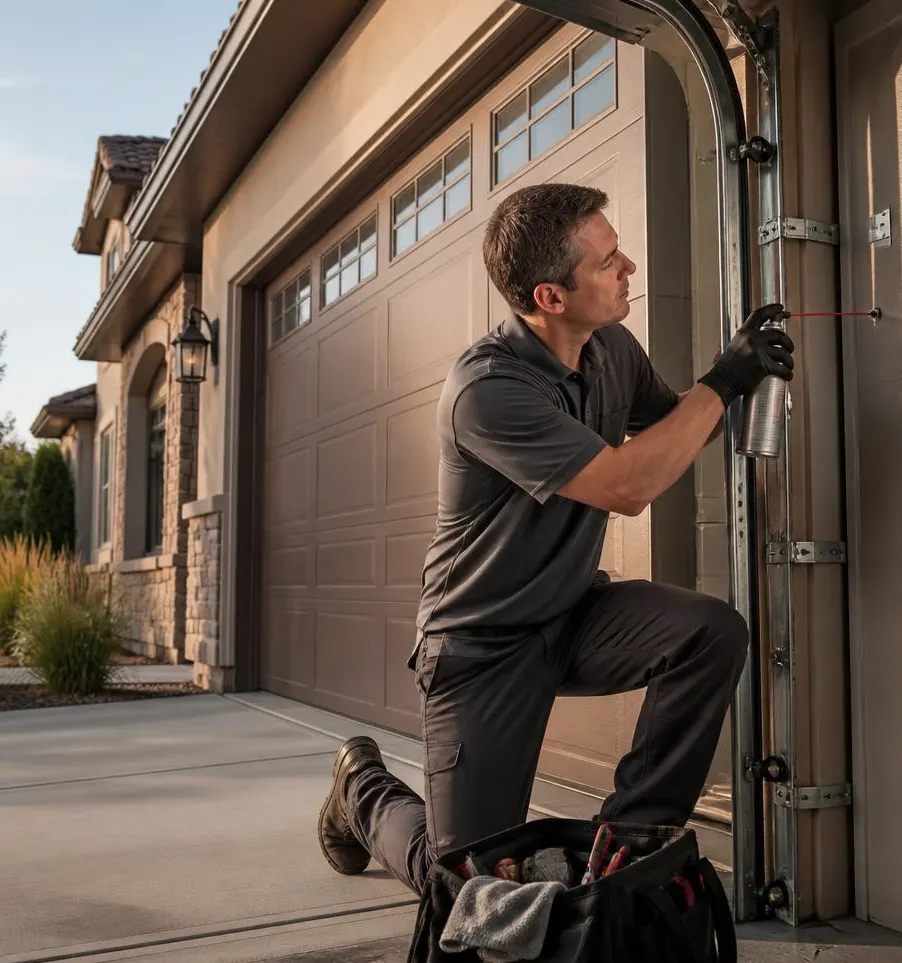
What a Technician Sees After the First Big Storm
Every year, the first serious wind-and-rain system of the season brings the same calls: a door that's bowed inward and won't roll smoothly, panels dented from flying debris, a bottom seal torn loose and letting water pool into the garage, or a door that's popped clean off one track after a strong gust caught it mid-cycle. Almost every one of these jobs started as a small, ignorable issue weeks earlier — a worn seal, a loose roller, a track that was a little out of alignment. By the time the wind shows up, there's no slack left.
Why the Garage Door Is a Home's Weakest Wall
Most exterior walls are built as continuous, braced sections. The garage door opening breaks that continuity — it's the single largest gap in the structure, often seven feet tall and nine to sixteen feet wide. When wind hits a closed house, the walls and roof resist the pressure as a connected system. But if a garage door isn't properly reinforced and it buckles or blows in, wind suddenly has a way inside the building envelope. Once that happens, pressure pushes outward against the roof and walls from the inside, which is a well-documented cause of roof and wall failure in high-wind events.
This matters more in older East Bay housing stock, where many garages still have original, non-reinforced panel doors with light-gauge tracks and minimal bracing. Homes that have been through seismic retrofits often have extra shear bracing added around the garage opening precisely because that wall section is already a structural weak point — but the door itself usually isn't part of that retrofit, so it stays the most vulnerable spot on the house.
Signs Your Door Is Vulnerable Going Into Storm Season
- Visible daylight or gaps along the sides or bottom of the closed door
- Panels that flex noticeably when you press on them from outside
- Rollers that are worn, rusted, or chipped
- A track that's bent, loose, or not perfectly parallel to the door
- Weatherstripping that's cracked, brittle, or missing sections
- A door that shudders, rattles, or sways when wind hits it while closed
- No horizontal reinforcement struts on the back of the panels (common on older, lighter doors)
Steps to Take Before the Rainy Season Peaks
- Tighten and inspect all hardware. Hinges, roller brackets, and track bolts loosen gradually with normal use. A loose bracket under wind load can let a panel twist out of its track.
- Check for horizontal reinforcement struts. These are the braces running across the inside of each panel. If your door doesn't have them, adding a wind-reinforcement kit is a relatively low-cost way to stiffen an existing door against wind pressure.
- Replace worn weatherstripping. The bottom astragal seal and the side/top seals keep wind-driven rain from forcing its way in. A compressed, torn, or shrunken seal lets water track across the garage floor during heavy rain.
- Confirm the track is straight and properly spaced. A track that's bent even slightly can let the door jump the rollers in a strong gust, which is one of the more common storm-season repair calls.
- Test the manual release and consider a battery backup opener. Power outages are common during winter storms; a backup battery keeps the opener functional, and knowing how to manually release the door matters if you lose power entirely.
- Keep gutters and downspouts directing water away from the door threshold. Pooling water at the base accelerates rust on tracks and hardware and finds its way under a worn seal fast.
- Secure or trim anything near the driveway that wind could turn into a projectile — patio furniture, loose fencing, overhanging branches.
Reinforcement Kit vs. Full Replacement
For most homes, a reinforcement kit on an otherwise sound door is the practical, lower-cost move — typically a few hundred dollars for materials and labor. But if your door is older, already shows panel damage, or your property sits in an exposed spot that catches more wind (open driveways, hillside lots, corner lots with no windbreak), a wind-rated replacement door is worth the higher upfront cost. It's a trade-off between patching up an aging door for another season or two versus installing something built to handle the gusts from the start.
When to Call Oakland Garage Door
If your door is already off-track, a panel is bent, or a spring looks stretched or rusted, don't wait for the next storm to test it. Oakland Garage Door handles Garage Door Repair for doors showing wind or water damage, Spring Replacement when a spring is too far gone to trust under load, and Garage Door Maintenance & Tune-Up to catch loose hardware, worn seals, and track issues before a storm finds them for you. We serve homeowners and businesses throughout Oakland, Berkeley, Alameda, San Leandro, Emeryville, Piedmont, Castro Valley, and Hayward.
Call Oakland Garage Door today to get your garage door inspected and storm-ready before the next East Bay rain system rolls in.